


The Ghost Franchise: Ranking the 10 Best Movie Sequels That Never Happened

"You can never see a movie that doesn't exist, but it exists in your mind as a perfect thing."
— Guillermo del Toro
Every true movie lover knows the specific sting of a "ghost project"—a film that existed entirely on paper, backed by passionate creators, only to be crushed by the cold machine of Hollywood studio politics. Sometimes a brilliant film fails to find its audience until it hits streaming or physical media, leaving risk-averse executives too terrified to roll the dice on a second entry. Other times, a visionary director pushes for an uncompromising, adult story, only for a studio to panic over the budget and opt for a cheap, corporate reboot instead.
These aren't just unmade scripts; they are lost cinematic milestones. From high-octane blockbusters sidelined by tragic real-world timing to masterfully paced psychological thrillers denied a green light by nervous executives, we are counting down the ten best movie sequels that were permanently left on the cutting room floor.
10. The A-Team 2

• The Hook: Joe Carnahan’s 2010 big-screen adaptation of The A-Team was a rare beast: a studio blockbuster that traded hollow CGI for visceral, practical momentum and a flawless ensemble cast. Bradley Cooper, Liam Neeson, Sharlto Copley, and Rampage Jackson had an infectious, charismatic chemistry that perfectly captured the spirit of the original series while updating it for a modern audience. Carnahan’s pitched vision for the sequel was famously unhinged, set to open with Hannibal (Neeson) mushing a pack of sled dogs across the brutal Sahara Desert to rescue a captive Face (Cooper).
• The Reality: The original film was a textbook victim of atrocious studio scheduling, opening directly against the massive cultural footprint of the 2010 FIFA World Cup and Sony's The Karate Kid reboot. While it found an incredibly passionate, highly profitable second life on physical media and cable television, the initial worldwide theatrical haul of $177 million wasn't enough to convince Twentieth Century Fox to greenlight another high-budget mission.
9. Grumpy Old Men 3 (Grumpiest Old Men)

• The Hook: Sometimes, the best reason to want a sequel is simply the desire to spend two more hours in the company of cinematic icons. Jack Lemmon and Walter Matthau possessed a legendary, unparalleled comedic chemistry built on decades of real-world friendship and flawless bickering timing. Following the box office success of Grumpier Old Men in 1995, Warner Bros. actively pursued a third chapter that would have sent the aging, stubborn neighbors on a final, chaotic vacation, recapturing the exact brand of comforting, character-driven humor that has largely vanished from modern studio slates.
• The Reality: This is a gentle, nostalgic tragedy rather than a bitter studio dispute. The project was entirely tethered to the unique magic of its two legendary leads, and Walter Matthau’s passing in 2000 officially and permanently closed the book on the franchise. As a cinephile, keeping this at number nine is an act of appreciation: while we never got the trilogy, the two existing films remain a pristine, unblemished legacy for Hollywood’s greatest comedic rivalry.
8. Hellboy 3

• The Hook: Guillermo del Toro’s first two entries are masterclasses in dark urban fantasy, trading sterile green screens for tactile, breathtaking practical effects, makeup, and creature designs. Ron Perlman's born-to-play performance as Big Red was slated to reach its mythic climax in a grand, apocalyptic finale. Del Toro’s blueprint for the third film was beautifully tragic: Hellboy would finally confront his dark destiny as the Beast of the Apocalypse, not out of malice, but out of absolute necessity to defeat an even greater evil to save humanity—all while settling into his new, domestic life as a reluctant father.
• The Reality: Del Toro’s uncompromising visual scale required a massive blockbuster budget of around $150 million. While Hellboy II: The Golden Army was a critical darling, its box office haul was heavily cannibalized by opening just one week before The Dark Knight in 2008. Unwilling to fund an expensive, R-rated fantasy epic, Universal Pictures opted to pass. Instead of giving fans the definitive closure they deserved, the studio eventually chose to execute cheap, critically panned corporate reboots, leaving del Toro's dark masterpiece permanently incomplete.
7. World War Z 2 (The David Fincher Cut)

• The Hook: Following the notoriously chaotic production and massive reshoots of the 2013 original, Paramount Pictures made a shocking, wildly exciting announcement: auteur director David Fincher was officially attached to helm the sequel. The thought of Fincher bringing his trademark icy precision, meticulous pacing, and intense psychological dread to a massive zombie canvas sent shockwaves through film culture. Rather than relying on the first film's generic, CGI-heavy action blockades, Fincher’s vision was a much more grounded, claustrophobic, and terrifyingly tense geopolitical thriller.
• The Reality: The project entered a grueling, multi-year cycle of script revisions as Fincher aggressively worked to keep the budget under control while preserving his specific creative vision. In early 2019, right on the absolute eve of entering full pre-production, Paramount suddenly pulled the plug. Terrified of a ballooning budget and a shifting theatrical market that was beginning to favor surefire superhero properties, the studio chose to kill the project entirely, denying audiences what would have easily been one of the most uniquely directed horror-thrillers of the decade.
6. Dredd 2

• The Hook: Pete Travis and Alex Garland’s 2012 adaptation of Dredd is a masterclass in economical, hyper-focused sci-fi action. It rejected the overblown origin-story tropes of the era to deliver a lean, relentless, tactical siege movie. Karl Urban gave a legendary performance, embodying the stone-faced Judge Dredd without ever removing his iconic helmet, while Olivia Thirlby’s rookie character provided the emotional and psychic anchor. A sequel would have blown the universe wide open, moving out of the claustrophobic Peach Trees mega-block and into the irradiated, lawless wasteland of the Cursed Earth, introducing the fan-favorite, supernatural Dark Judges.
• The Reality: Dredd was tragically undermined by a deeply flawed theatrical marketing campaign that overemphasized a dying 3D gimmick and failed to convey the film's sharp, gritty edge. It crashed at the box office, grossing a meager $41 million globally. However, when the film hit Blu-ray, DVD, and streaming services, it became an instant, massive cult phenomenon. Despite years of passionate fan petitions and Karl Urban’s vocal eagerness to return, risk-averse studio executives simply couldn't look past the initial theatrical spreadsheet, leaving one of the best comic book adaptations of the 2010s dead in the water.
5. District 10

• The Hook: Neill Blomkamp’s District 9 exploded onto the scene in 2009 as a groundbreaking triumph of original science fiction. It brilliantly used a gritty, found-footage mockumentary style to construct a powerful allegory for apartheid, institutional segregation, and corporate greed. The film ended on one of the most agonizing, haunting cliffhangers in sci-fi history: a fully transformed Wikus van de Merwe (Sharlto Copley) crafting a metal rose in the slums, waiting for the alien Christopher Johnson to fulfill his promise to return in three years with a cure. A sequel, titled District 10, promised to finally resolve that betrayal and show the catastrophic geopolitical fallout of the alien mothership's return.
• The Reality: Blomkamp has repeatedly confirmed over the years that he and Copley have written drafts for the sequel, aiming to base the narrative on a specific, stripping turning point in American history. However, the project has remained stuck in perpetual development limbo. As Blomkamp pivoted to other Hollywood studio films, independent sci-fi projects, and gaming media, the initial lightning-in-a-bottle momentum faded. Finding a studio willing to back a mid-budget, heavily political, R-rated sci-fi epic without diluting its raw, visceral edge has kept the alien mothership permanently out of reach.
4. Atomic Blonde 2

• The Hook: David Leitch’s 2017 neon-drenched espionage thriller proved that Charlize Theron is one of the premier action stars of her generation. Atomic Blonde was a masterclass in visceral physical momentum, highlighted by a staggering, brutal, ten-minute continuous-take staircase brawl that set a new benchmark for practical stunt choreography. Theron's Lorraine Broughton was a fascinatingly cold, calculating protagonist operating in the dying days of the Berlin Wall. A sequel promised a return to that synth-forward, hyper-stylized world, shifting the focus to a new geopolitical flashpoint in the early 1990s and allowing Theron to unleash even more meticulously rehearsed, bone-crunching choreography.
• The Reality: Despite turning a solid profit and building a dedicated cult following, the theatrical landscape quickly shifted, leaving mid-budget, adult-targeted action movies in a precarious position. In 2020, Netflix officially stepped in to acquire the development rights for a sequel, intending to fast-track it for their streaming platform. However, the project quietly languished in corporate development hell. As Theron’s schedule filled up with other blockbuster commitments and Netflix prioritized broader, franchise-starting intellectual properties, the momentum officially fizzled out, leaving Lorraine Broughton’s next mission permanently classified.
3. The Nice Guys 2
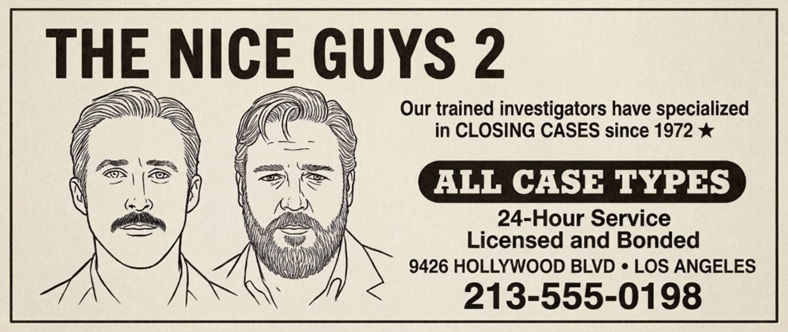
• The Hook: Shane Black’s 2016 buddy-cop masterpiece is a masterclass in original, character-driven filmmaking. The film boasts a flawless, subversively funny comedic dynamic between Ryan Gosling’s bumbling, opportunistic private eye Holland March and Russell Crowe’s cynical, heavy-hitting enforcer Jackson Healy. Packed with Black’s trademark razor-sharp dialogue, brilliant structural pacing, and an infectious 1970s aesthetic, the film left audiences desperate to see the duo tackle a brand-new, convoluted conspiracy in the glitzy, corrupt underbelly of 1980s Los Angeles.
• The Reality: The Nice Guys is the ultimate modern cinema tragedy. While it was showered with universal critical acclaim and remains an endless source of internet adoration, general audiences completely failed to show up at the box office, resulting in a meager $62 million global theatrical haul. In a Hollywood ecosystem that rarely greenlights sequels unless the original makes a half-billion dollars, the film was effectively dead on arrival. It stands as a frustrating monument to a painful reality: audiences frequently demand original, non-franchise storytelling, but rarely buy the tickets to support it.
2. True Lies 2

• The Hook: James Cameron’s 1994 original was a towering cinematic achievement, perfectly balancing explosive, pre-CGI practical spectacle with a razor-sharp, screwball marital comedy. Arnold Schwarzenegger and Jamie Lee Curtis shared an electrifying on-screen chemistry, supported flawlessly by Tom Arnold’s cynical comedic relief. The film was a massive global box office juggernaut, and by the turn of the millennium, Cameron had a complete, fully drafted script ready to go. The original cast was officially locked in to return for another high-budget, globetrotting action-comedy blockbuster that promised to push the boundaries of practical stunt work.
• The Reality: Unlike most entries on this list, True Lies 2 wasn't killed by a risk-averse studio executive or a poor box office showing; it was permanently derailed by the tragic real-world events of September 11, 2001. In the wake of the attacks, Cameron looked at his completed script—which heavily featured lighthearted, comedic blockbusters centered around global nuclear terrorism—and realized the tone was suddenly completely inappropriate for a changing world. Acknowledging that terrorism could no longer be treated as a breezy backdrop for a Hollywood popcorn movie, Cameron officially shelved the script, closing the book on the franchise forever.
1. The Millennium Trilogy (The David Fincher Trilogy)

• The Hook: David Fincher’s 2011 adaptation of Stieg Larsson’s international bestseller is an icy, masterfully shot, and uncompromisingly dark psychological thriller. Rooney Mara delivered a transformative, career-defining performance as the brilliant, fiercely independent Lisbeth Salander, paired flawlessly against Daniel Craig’s methodical Mikael Blomkvist. Backed by a haunting, Academy Award-winning synth score by Trent Reznor and Atticus Ross, the film was designed to kick off a definitive, book-accurate trilogy, tracking the deeply disturbing, convoluted corporate and familial conspiracies of The Girl Who Played with Fire and The Girl Who Kicked the Hornets' Nest.
• The Reality: Despite earning critical acclaim and a substantial $232 million worldwide, Sony Pictures panicked over the return on investment. Because Fincher refused to compromise his stark, R-rated artistic integrity to chase a broader PG-13 audience, the production required a massive adult drama budget that risk-averse executives simply grew too terrified to fund. Rather than letting modern cinema’s most meticulous director finish a landmark mystery saga, the studio let the cast's contracts expire and eventually opted for a cheap, soft reboot years later. It stands as the absolute number one tragedy of unmade cinema—a chilling reminder of a studio system that would rather abandon a masterpiece than take a financial risk on adult art.
Back from the Dead: The Sequel That Actually Escaped Development Hell
Sicario 3

For nearly a decade, fans of the grim, sweat-soaked border universe crafted by Taylor Sheridan have felt like Matt Graver waiting on an elusive target. The brilliant, synth-forward dread of the original films captured lightning in a bottle, equating the cartel landscape to a living, breathing monster. Yet, year after year, a third entry seemed completely marooned in studio limbo—plagued by silent cast negotiations, shifting budgets, and the agonizing question of whether a true mid-budget adult crime thriller could even survive in the modern blockbuster landscape.
Thankfully, the gridlock finally broke. In an incredible victory for fans, the headline update isn't just that a third film is happening—it’s that Emily Blunt is officially returning to reprise her role as FBI Special Agent Kate Macer. Having sat out the 2018 sequel, her inclusion finally reunites the original powerhouse trio alongside Benicio del Toro’s Alejandro and Josh Brolin’s Matt Graver. Backed by a gripping new narrative framework from Peaky Blinders creator Steven Knight and directed by Padraic McKinley, the project has officially broken out of development hell. While the other entries on this list remain permanent ghost stories, this is the rare Hollywood miracle where patience actually paid off. The monster is officially waking up.
Conclusion: The Legacy of Hollywood's Ghost Projects
Ultimately, these ten unmade sequels remind us that cinema is a fragile art form, constantly caught in a tug-of-war between pure creative passion and cold corporate calculations. It is a profoundly frustrating irony of the modern industry that while brilliant, character-driven masterpieces are left to gather dust in development hell, audiences are routinely inundated with inexplicable, unearned sequels to films that never needed a second chapter in the first place.
Yet, while it is easy to feel unfortunate about the missing trilogies and unresolved cliffhangers left on the cutting room floor, their legendary "what-if" status keeps them alive in our collective imagination. They stand as a testament to the brilliant visions of the filmmakers who refused to dilute their work, proving that sometimes, the movies we never got to see are the ones that stick with us the longest.


