Lioness Season 3 Finale Recap & Review: Domestic Extinction and the Price of Betrayal


“In the event you actually have a child, your next battle will be to live life for your causes… or live it for theirs.” — Joe, Lioness
PLEASE BE AWARE OF THE SPOILER WARNING DETAILING THE FINAL SCENE OF THE EPISODE. IT'S AT THE END OF THE ARTICLE. DEFINITELY WATCH THE EPISODE FIRST.
The architecture of a Taylor Sheridan finale rarely accommodates the luxury of a clean slate; instead, it offers the cold, mathematical inventory of systemic ruin. In the monumental, long-form conclusion of Special Ops: Lioness Season 3, Episode 8, titled "The Unravelling," the overarching promise of the title is fulfilled with a devastating, multi-layered finality. Written with an unsparing, panoramic gaze into the moral vacuum of modern statecraft, this extended hour serves as the ultimate collision between the surveillance state's total domestic dominance and its absolute operational vulnerability abroad. The machinery of American intelligence is exposed not as a flawless shield, but as a reactionary monolith—a system that can monitor every highway camera and track license plates across state lines, yet remains completely blind to the corporate and geopolitical venality operating within its own borders. "The Unravelling" strips away the remaining illusions of institutional control, delivering a heavy, character-driven masterclass in tradecraft cynicism that leaves our operators physically victorious, textually compromised, and utterly marooned in an empty world of their own design.
What makes this chapter so profoundly tragic is its uncompromising focus on the cost of institutional tunnel vision. The narrative structures itself around a series of deep psychological fractures—separating the clinical, automated intelligence centers from the raw, blood-soaked reality of field operations. As the hour moves through public assassinations, black-market revelations, and bureaucratic executions, Sheridan builds to a devastating realization: the perimeter didn’t just fail; the concept of a secure sanctuary was a myth all along. The true horror of the security state isn't that it cannot protect its primary assets, but that in its desperation to preserve itself, it systematically liquidates its own innocence, leaving its most lethal weapons to return home to nothing but empty rooms and the silent echo of their own betrayals.
The All-Seeing Monolith and the Automated Net
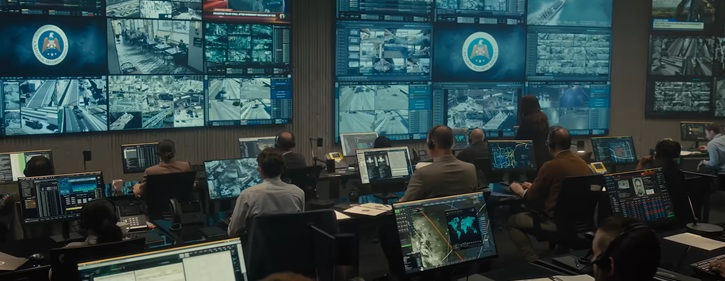
The finale establishes its tone immediately through a sequence of cold, mechanical surveillance shots. The opening frames are a stark, unblinking inventory of the modern panopticon: traffic cams, automated flock readers, and commercial security feeds capturing the mundane rhythms of domestic life. Sheridan forces the audience to confront the scale of the contemporary surveillance state, tracking the automated harvesting of civilian data straight into the heart of the NSA Intelligence Center. The room itself is a cathedral of clinical voyeurism—a sprawling, subterranean cavern filled with countless digital screens covering nearly every inch of every wall, crackling with the low, electric hum of global monitoring.

Within this digital net, a single variable triggers a red flag. A license plate reader registers a vehicle driven by a Russian national named Dmitri Sokolov. The system immediately spits out his cold, institutional pedigree: a Master’s degree in international relations from the London School of Economics in 2011, a green card secured in 2018, and a corporate history as an energy sector lobbyist at Akin Gump and BGR. When the escalation of the Ukrainian conflict forced domestic K-Street firms to drop foreign clients, Sokolov transitioned to the Center for Strategic and International Studies (CSIS). Recognizing the immediate tactical value of the hit, an operative dials a direct line to Byron.
The corporate history instantly locks the focus of the administrative apparatus. Recognizing Sokolov’s deep historical ties representing Lukoil and Gazprom across the African theater, Byron orders an immediate, comprehensive SIGINT team deployment to intercept his digital footprint. Hanging up with the NSA center, Byron routes an immediate call to Meade, bypassing standard operational channels to demand direct access to her husband, Errol. Standing in his office—a space defined by walls lined with heavy military decorations signaling a long, violent history in the field—Byron waits as Errol accesses his private corporate intelligence contacts to verify the target. Errol confirms that Sokolov's primary corporate focus was foreign energy exploration, a detail that perfectly aligns with the agency's brewing geopolitical anxieties. Meade suggests deploying Kyle to run a tight, localized surveillance operation on the asset. The automated net has found its target, and the gears of statecraft begin to grind.
The Last Mile of Witness Protection
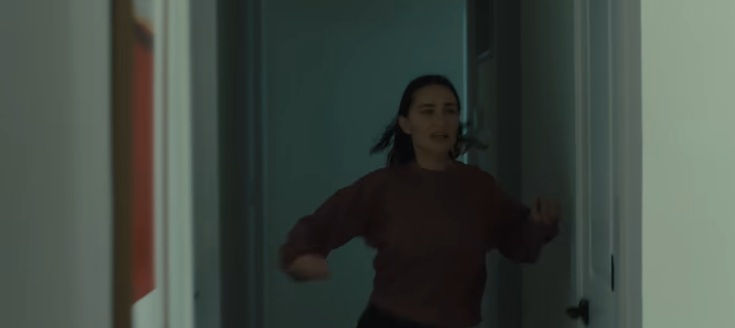
The narrative abruptly cuts from the high-tech corridors of Washington to the quiet, domestic isolation of Oklahoma City. Oleksandra Balakin is attempting to scrub away the lingering residue of her past life, showering in the quiet sanctuary of her safehouse. As she exits into the bedroom, completely naked and searching her closet for clothing, the atmosphere instantly shifts. Sheridan builds the sequence with an eerie, score-free silence, letting the natural audio design create a profound sense of isolation until Oleksandra's instincts flare. She senses a physical presence behind her.

Her instincts are proven correct. Cody J is standing menacingly in the center of the room, his eyes unblinkingly scanning her naked body. Though technically an ally under the payroll of the American government, his aura is heavy with a hostile, predatory coldness. Cody J flatly informs her that her perimeter has been compromised; the agency is executing an immediate, forced evacuation—new identity, new credentials, new location.
Oleksandra, hardened by decades of survival within the SVR, sees right through the deception. She knows the clinical logistics of American intelligence; relocating a protected federal asset is the explicit mandate of the U.S. Marshals Service, not an unannounced black-ops extraction by a CIA cleanup crew. The realization of her absolute betrayal flashes across her face. Recognizing that going with him means a shallow grave, she bolts for the door, only to be violently intercepted and slammed against the wall by Grady, who steps from the hallway to seal her exit. It is a chilling, quiet execution of bureaucratic utility—the definitive proof that once an asset's intelligence is harvested, the state views their survival as a liability.
Trojan Horses and the Flight from Virginia
Back at the Langley headquarters, Joe is found asleep on her office couch, her body locked in the exhausting, painful grip of trauma. When Meade enters the office to wake her, Joe bursts upward with an aggressive, violent defensive reflex that forces Meade to take a step back in surprise. Joe doesn't offer a standard professional apology; instead, she looks at her director and delivers a stark, unvarnished truth: "That should answer the 'Why didn’t I go home?' question."
Meade accepts the reality silently, handing her a cup of coffee as Joe lays down her operational ultimatum: she will not rest, sleep, or step out of the grid until every single culprit involved in her suburban abduction is permanently dealt with. Meade reveals that the current digital trail points directly back to Balakin. Joe’s tactical instincts immediately reject the theory, but Meade places the burden of proof squarely on Joe's shoulders. To extract the truth, Meade reveals a shocking political compromise: the administration is officially releasing Aleksi Yurimov from federal custody.

The revelation hits Joe like a physical betrayal. The entire violent trajectory of their season began with the high-risk capture of Yurimov, and now the state is simply opening the cage. Meade explains the cynical, macroscopic calculus of the choice: the move is purely political. The United States cannot publicly denounce Joe's illegal abduction on domestic soil while simultaneously holding a foreign commander captured under the exact same parameters. If Russia orchestrated the snatch-and-grab, releasing Yurimov into their custody will reveal nothing; but if a rogue Ukrainian faction is pulling the strings, a liberated Yurimov will be hyper-motivated to hunt down the architects of his betrayal. Meade asks if Joe is physically capable of running the interrogation on the flight home. Standing on a missing toe, her body battered, bruised, and limping, Joe looks her director in the eye and accepts the mission. Meade nods, noting that once this operation is wrapped, they are scheduled for a long, non-negotiable talk regarding Joe's future—a bureaucratic code for a forced desk designation that Joe is not ready to face.
Cold Common Ground and the 9/11 Intuition
The narrative moves to a high-end Washington restaurant where Mullins sits in silence, waiting for Byron to arrive. Moments after Byron takes his seat, they are joined by Maxim Petrov, the sharp, calculating face of Russian intelligence. From the opening exchanges, Mullins steers the conversation toward a diplomatic thaw. He explicitly voices a desire to find common ground with the Federation, seeking to lower the temperature of the proxy conflict before it triggers a hot war. Petrov counters with predictable, mocking hostility, but eventually allowed the conversation to return to the table.

Byron drops the administrative hammer: the United States is holding an asset belonging to the Russian Federation, and they are prepared to return him by the end of the day—Aleksi Yurimov. At the mention of the name, Petrov’s standard diplomatic smile vanishes. The SVR was operating under the explicit, state-manufactured narrative that Yurimov had been killed in action on the Ukrainian front lines. Recognizing the massive leverage of the gift, Petrov demands to know the American price. Mullins responds with a single, chilling word: "Nothing."
The release is designed as an absolute mechanism to cool global relations. Mullins makes it clear that American intelligence has confirmed Russia was not the operational hand behind the two separate abduction attempts on Joe. Petrov takes in the information, recognizing that despite their technical superiority, the Americans are still completely blind to the identity of their true enemy. He looks across the table and delivers a blistering critique of American arrogance: "The whole world hates you. Even your friends."
Once Petrov departs, Mullins is left in a state of profound frustration. The diplomatic maneuver hasn't brought clarity; it has amplified his anxiety. He looks at Byron and admits that they have missed a critical variable in the equation. When Byron asks him to quantify the feeling, Mullins delivers an unsettling baseline: "Want to know the last time I had this feeling? About a week before 9/11."

The Restaurant Bloodbath: Compromised Judgment in Broad Daylight
The operational focus shifts to Kyle, who is maintaining a loose visual tail on Dmitri Sokolov as the asset enters a upscale, crowded D.C. restaurant. Outside, Tex and Randy execute their support roles; Tex runs a textbook distraction on the valet staff while Randy approaches the vehicle to plant a hard GPS tracker on the bumper. The mission parameters are explicitly restricted: this is a simple trail-and-report protocol designed to map Sokolov's contacts.
Kyle takes a seat at the counter, securing a clean line of sight to the target who has moved toward the back of the establishment. Inside the NSA hub, technicians intercept the restaurant’s security cameras, feeding real-time digital angles directly to Kyle’s HUD. Scanning the floor, Kyle notes two armed security guards keeping a protective watch over a foreign woman who appears to be a high-level diplomatic representative of an African state. Moments later, a man steps through the front entrance, addresses the hostess, and walks toward the back.

When the camera catches his face, the entire operation hits a critical threshold. It is the bald Belarusian agent—the primary field architect of Joe’s abduction. Kyle has no idea who he is; Joe is the only operator who has ever looked into his eyes and survived. But as the Belarusian takes a seat directly opposite Sokolov, the NSA center flags the anomaly.
Sitting across from the asset, the Belarusian agent updates him on the collapse of the Texas exfiltration. He states that the speed of the American rescue suggests a severe internal mole within their own network, leaving his remaining extraction team completely stranded inside the United States.
Meanwhile, aboard a private jet transit, Joe and the QRF are airborne en route to Yurimov’s location. Bobbi is monitoring the live feed of Kyle’s surveillance, questioning his positioning until Joe steps up to look at the screen. The shock is instantaneous. Staring at the daylight feed, Joe identifies the Belarusian agent.

Cruz immediately routes a high-priority tactical alert to Tex and Randy outside the restaurant, identifying the Belarusian as a Level 1 HVT. The trail-and-report protocol instantly fractures. Staring down a high-risk engagement in a heavily populated civilian zone, Tex demands a definitive operational directive: "Tail or engage." Driven by an overwhelming wave of personal fury and compromised judgment, Joe delivers the fatal command: "Engage. Now."
Tex and Randy enter the building with zero subtlety, their intentions instantly written in their posture. Spotting them immediately, the Belarusian agent recognizes that his perimeter has collapsed. Standing up from the table, he pulls a concealed pistol and executes Sokolov in cold blood in front of the entire restaurant.
The room explodes into absolute chaos. As civilians hit the deck in terror, Tex and Randy open fire, systematically dropping the Belarusian agent with precision rounds. But the public nature of the execution triggers a catastrophic chain reaction. The two foreign guards protecting the African dignitary have no tactical context; they simply see two unidentified gunmen executing a man and turning their weapons inside a crowded room. Acting on their protective mandates, the guards draw their sidearms and open fire on Tex and Randy.

Left with no operational alternative, the operators are forced to return fire, terminating the guards in self-defense. But the crossfire is unforgiving. Randy takes a round to the shoulder, Tex is dropped by two severe gunshots to the gut, and the foreign dignitary is left bleeding out on the floorboards from multiple stray rounds. Watching the digital feed from the aircraft, Joe is hit by the immediate, sickening realization of her failure. Her judgment was warped by her trauma. She should have ordered a tail. The bloodbath is entirely on her hands.
Gitmo and the Black Work Economy
The team deplanes from the jet, moving directly onto a waiting helicopter piloted by Carrillo to execute a hard transit to Guantanamo Bay. Aboard the aircraft, the silence between Carrillo, Two Cups, Bobbi, Cruz, and Joe is heavy with the weight of the D.C. disaster. Arriving at the military base, the auditory environment is dominated by the relentless, blasting roar of heavy metal music—the systematic application of "music torture" designed to break the sensory baselines of the inmates.
They march through the open area to a section of chain link fenced cages where Yurimov is being held. The guard binds his hands, prepping him for his political release. But as they begin to escort him out, a secondary prisoner calls out to Joe from an adjacent cage, claiming explicit knowledge of her identity. Dismissing it as a baseline interrogation tactic, Joe continues walking, only for the inmate to shout out accurate, hyper-classified personal details that stop her dead in her tracks.

Joe approaches the cage, demanding to know how a Gitmo detainee knows her name. The prisoner looks through the fence and delivers a line that dismantles the entire premise of the season: "You were shopped."
He reveals that her abduction was never a direct state-sponsored wet-work mission executed by a single foreign government. Instead, the assignment was outsourced to the open market, shopped to private contractors like a corporate asset. Recognizing the staggering value of the intelligence, Joe orders the team to pull him from the cell. He is joining the flight.
Apologies and Adversaries at 30,000 Feet
Before takeoff, Yurimov is permitted his first clean shower in weeks—a profound testament to how rapidly the small luxuries of the civilian world regain their significance after prolonged captivity. As he exits into the main room, fresh and dressed in clean clothing, Bobbi and Two Cups are waiting to offer him a seat and a bottle of water that he consumes with desperation.
In an interrogation room still somewhere at Gitmo, Joe interrogates their new prisoner asset. He confirms that the SVR originally shopped her profile on the open market. When Joe displays a digital photograph of the bald Belarusian agent executed in the D.C. restaurant, the asset is surprised she knows this man: "You knew already? That's who shopped you."

He breaks down the terrifying reality of the modern shadow economy: the Belarusian was a mercenary who played both sides of the curtain, balancing contracts for the Russian SVR, the Chinese MSS, the CIA, MI6, Mossad, and the Iranian MIS. He defines it as the definitive line between the politics of black work and the business of black work—a landscape dominated not by flags, but by multinational corporate interests like AngloGold, Kumba Iron, Sinopec, and CNPC. Joe spies for her country; the Belarusian spied for a ledger. Joe offers him a complete identity scrub and entry into witness protection in exchange for the entire logistics map, making it clear that his only alternative is a permanent return to the cages of Gitmo.
Now at cruising altitude, Meade calls Joe to deliver a medical update: Randy is stable and recovering, but Tex remains in critical surgery, fighting for his life. Joe sits down across from Yurimov, who has accessed the cabin's food and beverage stash. When the Gitmo asset attempts to do the same, the QRF moves into his face, violently enforcing the boundaries of his status until Two Cups escorts him to the lavatory with his typical, sarcastic wit making a joke about "playing swords with a Russki."
Left alone, Joe looks across the table at Yurimov and delivers a quiet, genuine apology for his original capture, stating she acted under the strict belief that it was necessary for global security. Yurimov holds no lingering animosity toward her. "You’re a soldier," he notes calmly. Joe counters by noting that the exact same violation was visited upon her, though she was pulled out before crossing the border. She notes that they took her from her private residence—and that the agency initially believed he was the architect.

Yurimov laughs, drawing a definitive moral line across the tradecraft landscape: “What you did to me is part of the game. That’s war. But to come to his home and take him in front of his children, that’s not war. That is kidnapping. That’s criminal.”
Joe asks if the erratic, criminal nature of the strike points toward Iranian intelligence. Yurimov agrees, defining Iran as a state comprised entirely of criminals and victims, operating purely out of fear and a desire for retribution. He asks if Joe has given Iran a specific reason to seek vengeance against her name. Joe terms Yurimov her enemy, but the Russian commander shifts the vocabulary: they are adversaries competing for control of a board; Iran, however, hates her on a visceral, personal level.
He notes that Ukraine has no logical placement in this calculus, and identifies the Gitmo asset as a operative he personally utilized during the Syrian campaign, advising Joe that if she asks the right questions, the man will map the entire network. Joe notes that the only questions that matter are about Iran. Yurimov pours her a drink, accepting her apology before leaving her with a chilling, professional baseline: “If I see you in Ukraine again… I’m going to kill you.” Joe smiles grimly: "Not if I kill you first." As they land and prepare to move to separate vehicles, Yurimov leaves her with a echoing final warning: "Never underestimate how many hate you."

The Hot Seat and the Open Market Manifest
Back in the Washington briefing room, the physical structure of the door cannot contain the sound of Byron screaming expletives at the top of his lungs. Joe listens briefly to the administrative explosion before entering the room to find Kyle sitting in the hot seat. Byron is absolutely livid, dismantling Kyle under the explicit assumption that the public bloodbath at the D.C. restaurant was the direct result of his unauthorized operational commands.
Joe steps to the side of the room, leaning into Meade to whisper a critical confession: it wasn't Kyle; she was the one who ordered the QRF to engage the target. Meade takes in the information with visible concern, instantly ordering Joe to keep that confession entirely to herself to preserve her remaining career infrastructure. Byron threatens Kyle with a punitive assignment to a desolate station in Africa to appease the diplomatic fallout of the dead foreign official before turning his focus to Joe.

Joe updates the directors on the Gitmo asset's intelligence: her abduction was explicitly shopped on the open commodity market, and she confirms with absolute certainty that Ukraine had zero involvement in the strike. The information hits Meade and Byron with a sudden, sickening weight. Seeing their somber expressions, Joe demands to know what they did. Meade coldly admits that when the administration was operating under the false belief that Ukraine was behind the abduction, a certain critical Ukrainian asset "had to be taken care of." Joe is visibly horrified by the casual liquidation of an innocent ally, but Meade shuts down the emotional response, writing it off as an unfortunate, necessary occurrence of statecraft.
Moving into the interrogation room with the Gitmo asset, Meade establishes the boundaries of his cooperation: she cannot promise an immediate show of force to guarantee his freedom, but she can absolute guarantee devastating consequences if he lies. Desperate to secure a ticket home, the asset lays out the entire corporate and operational blueprint of the black-ops market.
He explains the network layers: there is a high-level broker in D.C. named Sokolov who handles the illegal logistics of moving high-value human cargo, black-market oil, and stolen assets onto international cargo ships. Sokolov answers directly to a contract agent named Renat, who remains actively employed by the Russian Federation. Looking at the monitors, the asset identifies the IDs of Sokolov and points to the Belarusian executed by Tex and Randy as Renat.

Renat had approached him with the original capture contract on Joe, offering $250,000 per operator. Recognizing that targeting a senior CIA case officer inside her own domestic sanctuary was a guaranteed suicide mission that would inevitably draw terminal retaliation from both the United States and Russia, he declined the contract. Joe demands the ultimate identity: "Who paid for me?"
The asset notes he only knows the parameters of the hiring entity: the contract originated through visas stamped with the mark of the "Master of the Martyr’s Brigade"—identifying the Al-Quds Force (KSS). He explains that the KSS operates as both an independent entity and a regional proxy; they earn private capital, but the contract must align with their ideological goals. Because Iran’s greatest strategic fear is direct, unmitigated retribution from the United States military, they utilize layers of deniability: Iran hires the KSS, the KSS hires Sokolov, Sokolov hires Renat, and Renat constructs the field team. The motivation is singular: retribution. Whoever financed the KSS was seeking personal revenge for a past violation. With the intelligence exhausted, Meade turns to Joe and issues an absolute, non-negotiable directive: go home.
A Pale Body in the Stream
The narrative cuts sharply to a public park in Oklahoma, where a civilian is running along a dirt path with his unleashed dog. The animal is highly obedient, but as they approach a small footbridge, the dog suddenly breaks its pattern, sprinting down the embankment toward the brush. The owner shouts for the animal, following its trail down into a secluded dirt path that runs parallel to a small, slow-moving stream.

Reaching the edge of the water, the man finds his dog sniffing at a large object in the mud. As the civilian approaches, the camera catches his expression of pure, unadulterated horror.
Lying face up in the dirt is the cold, pale corpse of Oleksandra Balakin. She has been dropped there like a piece of worthless administrative trash, her skin gray against the mud—a silent, devastating testament to the clinical efficiency of the cleanup operation ordered by Meade and Byron. She did everything the American government asked of her, and her reward was total erasure in a ditch.
The Domestic Extinction and the Empty Drawer
Bobbi and Carrillo escort Joe back to her Virginia residence, pulling up to the curb in the quiet daylight. The moment the vehicle stops, the visual landscape delivers a devastating psychological blow: a bright "For Sale" sign is staked into the front lawn. The team instantly recognizes the finality of the image. Joe sits in the backseat, staring at the wooden sign, knowing with absolute certainty what it represents.
The QRF exits the vehicle to conduct a tactical sweep of the property as a standard security precaution. Joe slowly steps out, her body limping as she approaches the front door. She allows Bobbi to cross the threshold first to clear the interior rooms.

As Bobbi signals the all-clear, Joe steps inside. The silence is deafening. The home has vanished with the family; the warm, chaotic sanctuary she spent three seasons attempting to balance has been completely evacuated. Walking into the empty kitchen, her eyes lock onto a lone piece of white paper left sitting on the clean counter—a final note left behind by Neal.
Joe sits down in an empty chair, her hands trembling with a terrified reluctance as she unfolds the paper to read his final words. Sheridan keeps the text of the note hidden from the screen, letting the pure, devastating collapse of Zoe Saldaña’s performance carry the entire weight of the scene.
In the hallway, observing her commander's total emotional destruction, Bobbi quietly gestures to Cruz and Carrillo to exit the house, giving Joe her final perimeter. Joe looks up and tells Bobbi to go home; the time for operational shields is over. Joe is left entirely alone to sink into her new reality. She wanders through the vacant corridors, opening closet doors only to find them stripped bare. The sock drawers are empty; the beds are unmade frames. Sitting down on the bare floor of her daughters' bedroom, the weight of her choices completely breaks her. She curls into herself, sobbing uncontrollably in the center of an empty room. The state has saved her life, but her home has suffered total extinction.

⚠️ SPOILER WARNING: THE DOHA REVELATION ⚠️
DO NOT READ PAST THIS POINT UNLESS YOU HAVE FULLY WATCHED THE FINALE
The absolute crowning achievement of "The Unravelling" occurs in its final, unvarnished final sequence—a textbook Taylor Sheridan "gotcha!" moment that completely recontextualizes the historical lineage of the entire series. The camera suddenly cuts across the globe to land in a lavish, palatial mansion in Doha, Qatar. The nighttime setting is drenched in opulence as a man paces across a sleek living room, speaking rapid, intense Farsi into a cell phone. The audience is left completely unmoored, tracking his movements through a labyrinth of concrete and marble corridors until he enters a secluded room lit entirely by dozens of scattered candles.
Approaching the threshold of an expansive bathroom door, the man switches to English, delivering a quiet, ominous update to an unseen figure: “So… they were close. But it didn’t work out. They missed for the second time.”
The camera slowly pans across the water, tracking a wet, feminine hand resting on the edge of the tub before tilting up to reveal the face of Aaliyah Amrohi.
The shock is absolute. The woman whose life Cruz shattered in the Season 1 finale—the vulnerable bride whose father and fiancé were brutally slaughtered in her own kitchen—is the definitive billionaire architect financing the global black-market net that captured Joe.
The man asks her what her next directive is. Lounging in the candle-lit water, her eyes completely devoid of the warmth she possessed two seasons ago, transformed into a cold, merciless sovereign of the shadow world, Aaliyah simply replies: “Try again. Maybe third time’s the charm.”

The operator pleads with her, arguing that orchestrating an immediate, localized execution on Virginia soil would be infinitely simpler than attempting to smuggle a senior CIA director across international borders. Aaliyah looks through the dimly lit ambiance and delivers the terrifying, systemic trap that will define the future of the series: “We have to get her out. If we get her out, the others will come to save her. And then we have them all.”
The circle is complete. The vengeance isn't coming from a foreign government or an abstract flag; it is the direct, bleeding consequence of the first season's operational success. The assets didn't just unravel the fence—they created a monster.
Out of 10
Story: 10 / Acting: 10 / Directing: 10 / Visuals: 9
OVERALL: 9.5/10
Final Thoughts on Season 3, Episode 8 -- "The Unravelling"
The Season 3 finale of Special Ops: Lioness is a monumental, staggering achievement that masterfully subverts the standard expectations of the military thriller genre. By spending the bulk of this massive hour on the slow, agonizing decomposition of tradecraft logic rather than pure action, Taylor Sheridan delivers his most philosophically resonant script in years. The visual contrast between the high-tech, all-seeing NSA hub and the pale, discarded body of Balakin in an Oklahoma ditch serves as a blistering indictment of the institutional coldness driving the security state. Zoe Saldaña delivers a career-defining performance, mapping the physical agony of her missing toe onto the absolute psychological destruction of her empty home.
By grounding the entire operational search in the concept of personal vengeance rather than macro-geopolitics, the series transitions into a deeply intimate, terrifying exploration of cyclical violence. The dialogue between Joe and Yurimov on the jet stands as a brilliant thesis statement for the entire series, separating the honorable boundaries of warfare from the criminal reality of personal retribution. As the curtain falls on a house stripped bare and a national security apparatus scrambling to lie to its own public, Lioness leaves its audience in a state of profound, breathtaking unease—a dark, uncompromising reminder that in the theater of black work, the premium of victory is often absolute isolation.